
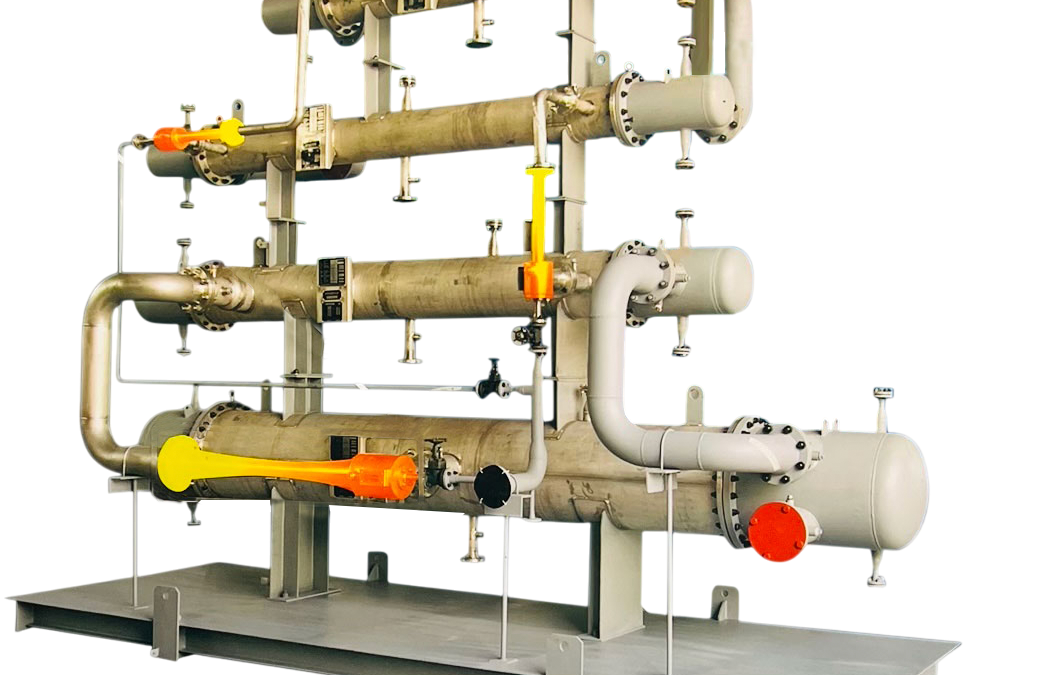
A steam jet ejector vacuum system is widely used in process industries where vacuum conditions must be maintained while handling mixtures of condensable vapors, non-condensable gases, air, and particulate matter. According to Croll Reynolds, these systems combine ejectors and condensers to provide reliable vacuum service across a wide range of process applications. The ejector uses high-pressure motive steam to generate a low-pressure region, entrain the process stream, and compress the combined flow, while strategically positioned condensers remove condensable components before the remaining gases enter subsequent stages.
Understanding the Difference between Condensable and Non-Condensable Loads
Process vacuum streams commonly contain two broad categories of materials: condensable vapors and non-condensable gases. Understanding their behavior is essential when designing and operating a multistage vacuum system.
Condensable vapors are gases that can change into liquids when their temperature or pressure reaches suitable conditions. Water vapor is one of the most common examples, although process streams may also contain solvents, hydrocarbons, or other vapors. When these vapors are condensed, their volume and load on downstream equipment can be substantially reduced.
Non-condensable gases behave differently. They remain in the gaseous phase under the available operating conditions and therefore continue through the vacuum system. Examples can include air, nitrogen, hydrogen, and other process gases. These gases must be continuously compressed and discharged because they cannot simply be removed through condensation.
How the Ejector Handles the Process Stream
The process begins when high-pressure motive steam enters the steam chest and passes through a specially designed converging-diverging nozzle. The nozzle converts pressure energy into high velocity, creating a low-pressure region near the suction inlet.
This pressure difference causes the process stream to enter the ejector. The high-velocity steam acts as the motive fluid, while the incoming process vapor and gases form the suction fluid. The two streams mix as momentum is transferred from the motive steam to the entrained process gases.
The resulting mixture enters the diffuser. As the mixed stream decelerates, part of its velocity energy is converted into pressure energy. This pressure recovery allows the stream to leave the ejector stage and move toward a condenser or the next stage.
The Role of Condensers in Removing Vapors
Condensers are normally positioned between ejector stages to remove condensable vapor from the process stream. This is particularly important in applications involving substantial vapor loads.
When the hot discharge from an ejector enters a condenser, heat is removed using a cooling medium. Condensable vapor changes phase into liquid and can then be collected and removed from the system. This reduces the amount of vapor that the next ejector must handle.
Removing condensables between stages improves the overall arrangement because downstream ejectors can focus primarily on the remaining gas load. It can also reduce the amount of motive steam required compared with attempting to compress the entire vapor load through every stage.
Two common condenser configurations are direct-contact and surface condensers. In a direct-contact condenser, the cooling medium comes directly into contact with the vapor. In a surface condenser, heat passes through heat-transfer surfaces while the process stream and cooling medium remain separated.
The appropriate condenser arrangement depends on factors such as process composition, cooling-water conditions, contamination requirements, and whether separation between condensate and cooling medium is necessary.
Handling Non-Condensable Gases
After condensable vapors have been removed, the remaining stream can contain significant quantities of non-condensable gases. These gases continue through the vacuum system because they cannot be removed by ordinary condensation at the available conditions.
The subsequent ejector stage entrains these gases and compresses them to a higher pressure. Additional condenser stages may remove any remaining condensable material before the gases reach another ejector. This repeated sequence allows the system to progressively compress the non-condensable load:
Ejector → Condenser → Ejector → Condenser → Final Ejector
The number of stages depends primarily on the required vacuum level and the conditions under which the system must operate. Multistage arrangements can therefore provide much deeper vacuum than a single-stage arrangement designed for the same overall discharge pressure.
Why Proper Staging Matters
The balance between condensable and non-condensable loads directly influences ejector performance. If excessive condensable vapor reaches a downstream stage, that ejector must handle a greater mass flow than necessary. Conversely, inadequate capacity for non-condensable gases can cause pressure to rise and prevent the system from achieving its design vacuum.
Cooling conditions are also important. Condensers depend on the temperature and availability of the cooling medium. Higher cooling-fluid temperatures can reduce condensation effectiveness, leaving more vapor in the gas stream and increasing the load on subsequent ejector stages.
For this reason, the number of ejector and condenser stages is determined from the required operating vacuum, process load, cooling conditions, and discharge pressure rather than simply selecting stages based on the desired vacuum level.
Applications across Process Industries
These systems are suitable for applications where process streams contain mixtures of vapor and gas. Chemical processing may involve distillation, drying, flash cooling, and other operations that generate condensable vapors. Refineries can use vacuum equipment in distillation and other processes involving hydrocarbon vapors.
Power plants use vacuum equipment to remove non-condensable gases and support efficient turbine and condenser operation. Other applications include product degassing in steel processing, controlled vacuum conditions in pharmaceutical manufacturing, and evaporation or crystallization processes in food and beverage production.
Their ability to handle condensable loads, non-condensable gases, liquids, and particulate matter makes ejector-based systems particularly useful for demanding process environments.
Conclusion
A steam jet ejector vacuum system manages complex process streams by combining high-velocity steam entrainment with staged pressure recovery and condensation. Condensers remove condensable vapors between stages, while subsequent ejectors progressively compress non-condensable gases toward the final discharge pressure. This staged approach helps maintain the required vacuum while accommodating substantial vapor and gas loads. Croll Reynolds provides ejector vacuum solutions designed around these principles, offering durable equipment for chemical, refinery, and power, pharmaceutical, steel, and food-processing applications where dependable vacuum service is essential.